How Rare Is Your Personality?
This is a fun quiz, not a scientific one. It asks twenty short questions about your preferences, reactions, and everyday choices, and then tells you how statistically unusual your particular combination is. Most people land somewhere in the common range, a smaller group lands in the moderately uncommon, and a small tail of people come out with a combination of traits that would show up in roughly one in a hundred.
The maths is real enough. Any single personality trait follows a roughly normal distribution, and combining several traits multiplies out quickly — a combination that looks individually unremarkable can still be rare as a whole. This is why "rare personality type" marketing works: most people are rare if you ask enough specific questions.
About four minutes. Do not take the rarity percentage too seriously; do enjoy the archetype label.
What this quiz measures
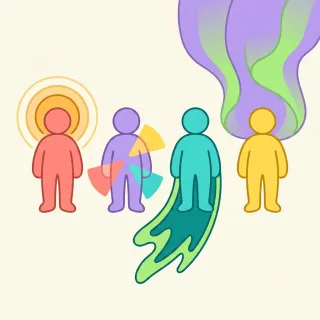
A mix of preference dimensions — social energy, decision style, emotional expressiveness, risk tolerance, conventionality — sampled with two items each. The score maps to one of four archetypes based on how unusual your combination is. "Heartbeat" is the most common cluster. "Prism" is moderately uncommon. "Comet" is rarer still. "Aurora" is the rare-combination end.
This is not a validated instrument. The rarity percentage is calibrated against typical responses to these specific items, not against a demographic sample. If you enjoy the result, share it. If you do not, retake in a week and see if you get the same one.
Sample questions
- What time of day do you feel most creative?
- In the evening, when the day is winding down
- During the morning, when everything feels fresh
- Late at night, when the world gets quiet
- Between 3 and 5 AM, in that strange stillness before dawn
- What triggers your deepest thinking?
- Reading something thought-provoking
- Having a meaningful conversation with someone
- Being in nature or watching something unfold slowly
- Repetitive motion like walking, showering, or doing dishes
- When you discover a new interest, what happens next?
- I gradually explore it alongside my existing hobbies
- I get excited and spend a bit more time on it than usual
- I research it thoroughly until I understand the basics
- I obsessively deep-dive for weeks, absorbing everything, then suddenly move on
Frequently Asked Questions
This is a playful quiz for entertainment. It is not a scientific measure of how unusual your personality really is.