What Is Your Love Language?
The love languages idea comes from a 1992 book by Gary Chapman, a Baptist pastor and marriage counsellor. Chapman noticed that couples in his practice often felt unloved even when their partners were clearly trying to show love — the problem was not effort, it was translation. He grouped affection into five categories: words of affirmation, acts of service, receiving gifts, quality time, and physical touch.
Academic researchers have not all been kind to the framework. The five categories do not hold up cleanly when people are asked to sort them; most of us respond to most of them. But as a conversation-starter for how you prefer to give and receive care, it works.
This 20-question quiz places you on the five dimensions and names an archetype for the combination. Answer based on what genuinely lands for you — not what you think a good partner should prefer. Four minutes.
What this quiz measures
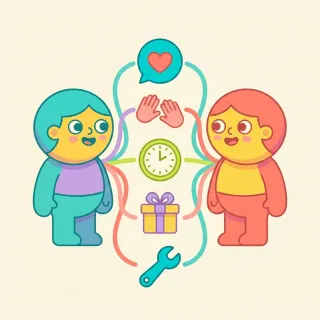
Five ways of expressing and receiving affection, each measured with 4 items. Words of affirmation (being told, not shown). Acts of service (someone doing something that makes your life lighter). Receiving gifts (the object matters less than being thought about). Quality time (undistracted attention). Physical touch (closeness as reassurance).
Most people are not monolingual. You probably respond to several, with one or two leading. The archetype we report is shorthand for your top-weighted combination — it is a sketch, not a diagnosis. The more useful data is the ranking across the five, particularly where your lowest score is. That is usually where miscommunication with a partner happens.
Sample questions
- How do you show a friend you care?
- I tell them exactly what I appreciate about them and why they matter
- A long hug or a hand on their shoulder says more than words ever could
- I clear my schedule so we can spend real, unhurried time together
- I handle something on their to-do list before they even have to ask
- How do you show gratitude?
- I write a sincere thank-you message explaining exactly what their kindness meant
- A warm, lingering embrace that says more than words
- I find or make a meaningful gift that captures my appreciation
- I return the favor by doing something helpful for them
- How do you show support during someone's stressful week?
- I send encouraging messages reminding them how capable they are
- I show up physically and sit with them, offering a calm, steady presence
- I clear my schedule and spend the evening with them so they feel less alone
- I take errands off their plate and handle what I can so they can breathe
Frequently Asked Questions
References
- Chapman, G. (1992). The Five Love Languages: How to Express Heartfelt Commitment to Your Mate. Northfield Publishing.
- Impett, E. A., Park, H. G., & Muise, A. (2024). Popular Psychology Through a Scientific Lens: Evaluating Love Languages From a Relationship Science Perspective. Current Directions in Psychological Science. A recent academic review of the framework's empirical support (or lack of it).
This is an informal self-assessment for entertainment and reflection. It is not a validated psychological instrument.