How Strong Is Your Logical Reasoning?
Logic is not a single skill. Philosophers have spent a few thousand years distinguishing between different kinds of reasoning — deduction (from rules to conclusions), induction (from examples to patterns), abduction (from evidence to the best available explanation), and procedural reasoning (breaking a problem into ordered steps). Most people use all four in daily life without naming them.
This quiz puts you through 20 short puzzles drawn from those four reasoning modes. Your score on each mode points to your default — the kind of problem you solve fastest — and your weakest mode is usually where your blind spots live. About five minutes.
The items are not trick questions. They are not harder than ordinary problems you encounter. The goal is not to stump you; it is to sort how you approach a problem when you have one.
What this quiz measures
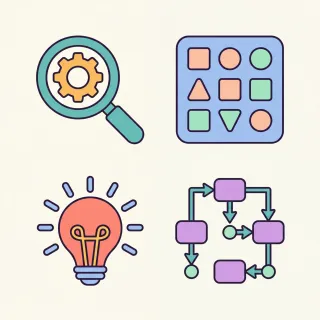
Four reasoning modes. **Deductive**: applying general rules to reach specific conclusions ("all crows are birds; this is a crow; therefore..."). **Inductive**: inferring general patterns from specific cases ("every crow I've seen is black, so probably..."). **Abductive**: working backwards from effects to the most plausible cause ("the floor is wet, and the dog just came in, so probably..."). **Procedural**: breaking a multi-step task into an ordered sequence, checking constraints at each step.
Almost nobody is strong on one and zero on the others. You will usually have a clear leader and a clear weakest mode. Your result archetype is shorthand for your top combination, but the dimensional scores — which you see alongside the label — are the more informative output.
Sample questions
- Your computer has been running slowly all week. How do you figure out what is wrong?
- I know that too many background processes cause slowdowns, so I open the task manager to confirm
- It started after I installed that new app, so I bet that is the cause
- Every time this has happened before, it turned out to be storage. I check the hard drive first
- I go through a checklist, storage, memory, startup programs, one by one until I find it
- You are meeting someone new and trying to figure out if they are trustworthy. What do you pay attention to?
- If their words and actions contradict each other, then they are not being honest. Simple as that
- I compare their behavior to patterns I have noticed in people who turned out to be reliable or not
- I form a quick impression based on the overall vibe and then see if anything contradicts it
- I observe how they treat different people, how they handle small commitments, and track consistency
- You need to plan a project but many things could go wrong along the way. How do you handle the uncertainty?
- I define the non-negotiable constraints first. If those are met, the project will succeed regardless of surprises
- I study how similar projects went in the past and plan around the risks that actually materialized
- I identify the single most likely thing to go wrong and build the plan around preventing that
- I create contingency branches. If A happens, we do X. If B happens, we do Y. Every path is mapped
Frequently Asked Questions
References
- Peirce, C. S. (1878). Deduction, Induction, and Hypothesis. Popular Science Monthly, 13, 470–482. The origin of the three-mode classification (deduction, induction, abduction).
- Johnson-Laird, P. N. (2006). How We Reason. Oxford University Press. A readable modern overview of how humans actually do logic.
- Kahneman, D. (2011). Thinking, Fast and Slow. Farrar, Straus and Giroux. On the gap between formal logic and how most people reason under time pressure.
This is an informal self-assessment for entertainment and reflection. It is not a validated test of reasoning ability or intelligence.